
Guastavino Tile at the University of Virginia
 Benjamin Hays is the University Building Official and Senior Engineer at the University of Virginia. He directs a team of architects and engineers responsible for administering building codes for all new construction and renovation work at the University, a UNESCO World Heritage Site, its hospital and academic grounds, the College at Wise, and the Blandy Experimental Farm. Hays is also a lecturer in the School of Architecture, where he teaches structural design and the history of building technology. His 2017 monograph “Reframing the Guastavinos at Thomas Jefferson’s University, 1896-1898,” won the 2nd Guastavino Biennial for research.
The 2011 Central Virginia earthquake caused damage to masonry structures in Washington DC, Culpepper, Baltimore, and beyond. At the University of Virginia, with its large inventory of historic masonry buildings, damage was fortunately confined to only a few locations. In Old Cabell Hall, a piece of structural tile and mortar from a late 19th century vault fell into the music library beneath the building’s main auditorium. Few vaults like this exist in Virginia and the immediate impact of the damage was unclear. Engineers from UVA Facilities Management contacted an expert on tile vaults, John Ochsendorf from MIT, to assess the stability of structure and propose mitigation strategies.
When John arrived in November 2011, I had just started working as a staff engineer at UVA, following a decade of engineering practice in California and Virginia. I was also working on a master’s thesis in architectural history at UVA’s School of Architecture. In joining the team to survey Old Cabell’s vaults in the music library, I learned an incredible story from John. The Guastavino company, who built Old Cabell’s vaults, had successfully completed hundreds of tile structures across the United States in the late 19th and early 20th centuries, including subway stations in New York City and the dome of the Natural History Museum in Washington DC. The footnote on their record was Old Cabell Hall. While in the music library, John told us that the vaults overhead had collapsed during construction and had killed several workers in the process.[1] He knew few details beyond a photo, letter, and a newspaper article he had seen in an archive in New York City and said the collapse was worth exploring further. I took the bait, changed my thesis, and have spent much of the last decade researching and teaching on the vaults in Old Cabell and the Rotunda.
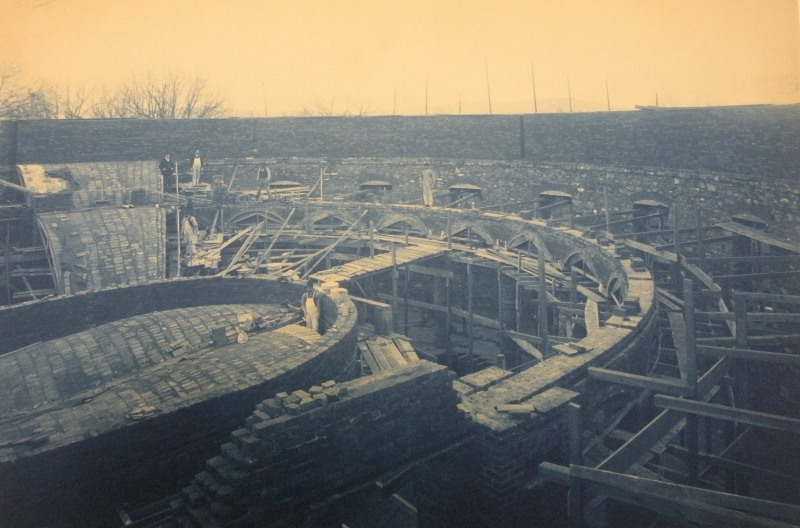
The tile vaults above Old Cabell’s music library are directly linked to the 1895 Rotunda fire. Following the fire, the UVA faculty requested that any repairs to Jefferson’s Rotunda – whose timber floors and wood ribbed dome had completely burned – be reconstructed using fireproof materials. The Guastavino family, who had emigrated from Spain to New York in the 1880s, quickly established themselves as designers of fireproof floor systems using a tile vaulting technology common to Catalonia. The University hired the New York City architectural firm of McKim, Mead, and White (MMW) to rebuild the Rotunda as well as design three new buildings, Old Cabell (then called the Academical Building), Cocke, and Rouss. Following a successful collaboration with MMW on the Boston Public Library in 1895, the Guastavinos were hired to provide fireproof floors, stairs, and the dome of the Rotunda as well as the vaulted floor system in Old Cabell Hall.

Through an extensive study of Old Cabell’s original drawings, construction photographs, historic newspapers, and the MMW and Guastavino archives in New York, I learned that the vaults did not collapse during construction as John had thought. Instead, one of the derrick cranes lifting the 17,000-pound primary roof truss broke, sending the mass of steel crashing onto the recently completed vaults below. Incredibly, the form and mechanics of the vaults meant that they were damaged only in the area near the collapsed truss. Repairs were made quickly and construction on the building resumed. What about the workers who had been killed? During my research, I also discovered that a concrete roof had collapsed at the Rotunda while it was being rebuilt and this collapse had been mis-attributed to the Guastavinos’ work.

Structural tile and arch forms are enjoying a bit of a resurgence after being sidelined by the engineering profession for most of the last century. Researchers at MIT, in Spain, and at ETH Zurich are producing structural applications for use in contemporary buildings. Closer to the Lawn, students in several of my classes have recreated models of the Guastavinos’ work here at UVA as well as free-form designs showcasing the material’s flexibility. While it is unlikely that tile structures with the large and complex geometry of the Guastavinos will return to construction sites anytime soon, hundreds of examples can still be seen overhead, including in the music library at the south end of the Lawn. So, if you’re looking for a quiet place to study, make your way over to Old Cabell Hall’s basement level and look up!

References
[1] Ochsendorf, John. 2010. Guastavino Vaulting, The Art of Structural Tile. Page 245, footnote 25.
- The Right to the City: Busking, Data, and Everyday Life
- The Stars and Stripes: 250 Years as an American Symbol
- Accounting Works: A Career Option
- UVA Club of Washington DC: Hoo's Ready for What's Next?
- Virginia Club of New York: July Wahoo Wednesday
- UVA Club of New River Valley: 2026 Summer Social & Student Send-Off