
Noah Webster Changed American English Forever
 Fred Borch is a lawyer and historian. He served 25 years in the Army as a uniformed attorney. After retiring from active duty, Fred took a job in the U.S. Government as the only career historian whose focus was exclusively on military legal history. He was Professor of Legal History and Leadership for 18 years at The Judge Advocate General's Legal Center and School located at the University of Virginia.
When Samuel Johnson published his two-volume A Dictionary of the English Language in 1755, he established what soon became the accepted standard of the English language in the British Isles. The British were convinced that Johnson’s dictionary would also be good enough for Americans. But this was not to be, as those speaking English in America had their own ideas about how the language they spoke should evolve. Enter Noah Webster, whose An American Dictionary of the English Language changed forever how we Americans speak and write English. Since Webster’s dictionary was published on April 14, 1828—198 years ago—now is the time to remember this great achievement.
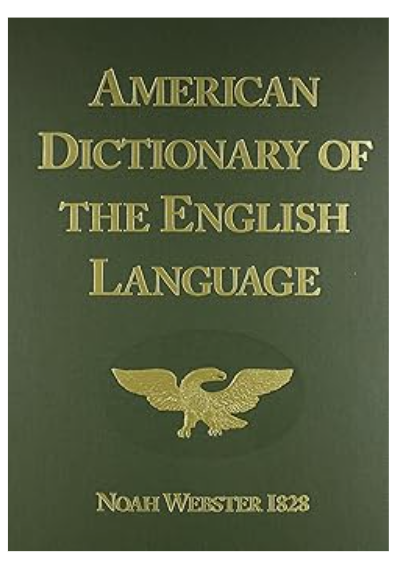
Born in 1758, Webster published his first dictionary in 1806 but almost immediately began working on a more comprehensive book, which he published on April 14, 1828. He was 70 years old and it had taken him more than a quarter century of research to complete the new dictionary, including time abroad in Paris, France and Cambridge, England.
Fascinated by the history of words, and convinced that he needed to know the root language of a word, its history, and how its form and meaning had changed over time, Webster learned ancient Greek, Hebrew, and Latin. He also studied Anglo-Saxon or Old English, the language spoken in the England before the Norman Conquest in 1066. Webster quickly discovered that a word’s original meaning might have little to do with its present-day usage in America.
Ultimately, his monumental work contained more than 70,000 words. Some twelve thousand had never previously appeared in a dictionary. Webster wanted distinctly American terms and political colloquialisms in his book, so he included words like skunk, squash, hickory, caucus, congress, applesauce and landside in the dictionary. Also appearing in his dictionary were Americanisms like copperhead, cookie, gimmick, fudge, notify, currency, hindsight, graveyard, moccasin, canoe, moose, toboggan, and maize.
More than anything else, Webster was a reformer when it came to spelling. He was convinced that English spelling was too complex, so his dictionary adopted American English spellings. Colour, harbour and neighbour became color, harbor and neighbor. Waggon and centre became wagon and center.
Although Noah Webster and his dictionary are now celebrated by those who study the English language, his original 1828 book sold poorly—only 2500 copies. Nonetheless, Webster continued his efforts and actually mortgaged his home to finance a second edition, which he published in two volumes in 1840.
This new dictionary was somewhat more of a commercial success, and it did have a definite impact on those who consulted it. Emily Dickinson, for example, used Webster’s Dictionary of the English Language in writing her poems. Her niece reported that she read it with “intense devotion” and that Dickinson saw the dictionary as an important creative tool; she liked how Webster defined words and provided illustrative quotations.
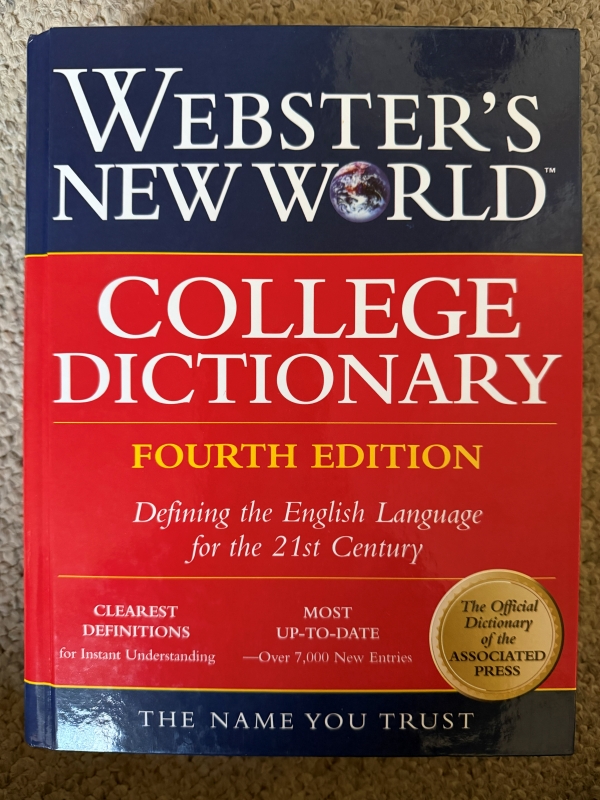
When he died in 1843, Webster could not have known that ultimately his dictionary would be the cornerstone of American English. The iconic status it enjoys today resulted from the efforts of his publishers, Charles and George Merriam. After acquiring the rights to his works in 1847, the Merriam brothers established the Merriam-Webster company and revised, updated and published the Merriam-Webster Dictionary. Their efforts live on today, and the unabridged dictionary at www.merriam-webster.com has more than 470,000 entries.
- Dolly Parton Appreciation Day (9-25)
- Choosing the Book: Protecting a Reading Life in an Age of Endless Scrolling
- Maybe We Shouldn’t Celebrate Positive Thinking Day
- Money Matters For Recent Grads: Use Your HSA to Save Today & Invest in Tomorrow
- Grounds for Conversation: an Evening of Dialogue and Discovery with Scott C. Beardsley in Houston
- Texas Wahoo Weekend